
Queenstown Medical Centre
What happens when patient emails reach the inbox
Marketing Automation · Email Deliverability
June 2026
Queenstown Medical Centre's patient emails were quietly failing to arrive. We lifted the post-visit survey open rate from 18% to 76% by fixing how the mail was delivered, not by rewriting it.
Patient emails, before and after the fix
76%
Post-visit survey open rate, up from 18%
+312%
More patients opening that email, about four times as many
4 of 4
Migrated emails that opened at a higher rate than before
+30%
Survey email click rate, up from 10.78% to 13.97%
0.8%
Bounce rate on the new sending setup
0.002%
Spam-complaint rate, effectively zero
An email no one opens is usually an email that never arrived.
Primary care for the Whakatipu community
Queenstown Medical Centre is the primary and urgent care provider for the Whakatipu community. A lot of its everyday contact with patients happens by email: post-visit follow-ups, autoresponders, appointment-related messages, and the satisfaction survey that tells the clinic how its care is landing.
For any of that to do its job, the emails have to arrive. A reminder that lands in spam is the same as a reminder never sent.


Patient emails that quietly never arrived
The post-visit survey that goes to people who have just attended the clinic was opening at 18%, which means more than four in five patients never saw it. These are not marketing emails; they are the operational messages a patient expects and a clinic relies on. What makes a problem like this hard is that nothing looks broken: the emails send, no error appears, they simply land in spam or the promotions tab instead of the inbox.
The failure had several roots, all below the surface:
- The sending domain had never been authenticated
- Mailbox providers had no proof the mail came from the clinic
- Must-arrive mail was sent on the same rails as marketing
- The failure was invisible: no bounce, no error, just silence
There was a second, quieter failure at the unsubscribe link. Because patient mail and marketing went out together, a patient who clicked unsubscribe (a link a CRM must include on marketing email) was usually opted out of everything, not just promotions. From that point the clinic could not email them at all, including the appointment and follow-up messages they still expected, and could not simply re-subscribe them. The clinic was writing good emails that most patients were never given the chance to open.
Fix delivery, not the message
The obvious response to a low open rate is to rewrite the emails. We judged the problem was not the message: an 18% open rate on mail a patient is expecting is a delivery symptom, so the work went to the layer that decides whether mail arrives.
Authenticated the sending domain
Set up the records that prove the mail genuinely comes from the clinic (DMARC and DKIM), so mailbox providers can verify the sender and stop filtering its mail to spam.
Moved patient mail onto transactional infrastructure
Routed the must-arrive emails through dedicated transactional infrastructure with a clean sending reputation, built for confirmations and surveys rather than for marketing blasts.
Reconfigured and documented every automation
Rebuilt each automation on the new setup and wrote up the workflows, so the clinic's team can run and maintain it without depending on us.
Left the copy alone, on purpose
No subject-line tests, no template redesign. Optimising opens on mail that was never reaching the inbox would have measured nothing.
More patients opening the mail that matters
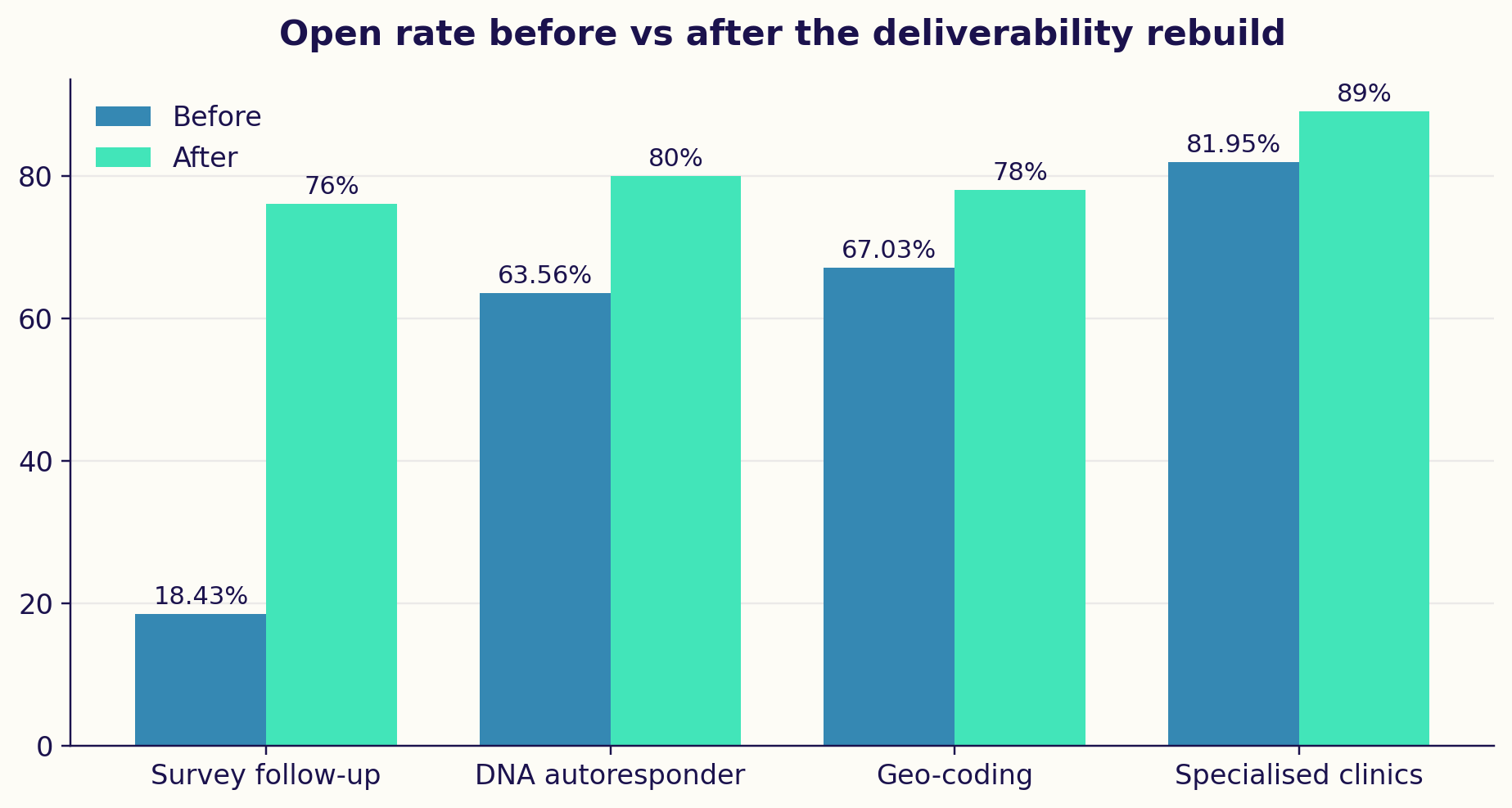
Once the domain was trusted and the mail was travelling on the right rails, open rates rose across every automation we moved. The mail started reaching the inbox, where a patient could open it.
76%
Post-visit survey open rate, up from 18.43%, more than four times as many patients opening it. It was the highest-volume email migrated, so the result rests on real numbers, not a small sample.
4 of 4
Every email moved onto the new setup opened at a higher rate, including the already-healthy ones: the DNA autoresponder rose from 64% to 80%, geo-coding from 67% to 78%, and the specialised-clinics email from 82% to 89%.
0.8%
Bounce rate on the new infrastructure, with a spam-complaint rate of 0.002%, close to zero. Delivery is healthy in its own right, not just better than before.
The meaning for the clinic is concrete and ongoing. It can now send a patient a follow-up, a reminder, or a survey and trust it will arrive, which makes the patient-experience data more complete and removes a silent failure no one could see.
What fixing email deliverability teaches you
Suspect delivery before copy
When an operational email opens far below where it should, the subject line is rarely the problem. A low open rate on must-arrive mail usually means it is not reaching the inbox.
Authentication is invisible until it costs you
Mailbox providers quietly decide whether a sender is trustworthy. An unauthenticated domain pays for it in mail that never arrives, with no error to warn you.
Keep must-arrive mail away from marketing
A confirmation or a survey has a different job, and a different delivery profile, than a campaign blast. Sending it on infrastructure built for it protects the messages a business cannot afford to lose, and stops one unsubscribe click from silencing everything.
Fix the foundation, and the mail gets through
Queenstown Medical Centre's patient emails were quietly failing to arrive. The post-visit survey, the one that feeds patient-experience tracking, was opening at just 18%. The cause was delivery, not content.
We authenticated the sending domain, moved the transactional mail onto infrastructure built for it, and documented the setup so it stays that way. The survey now opens at 76%, every migrated email improved, and delivery is healthy. The clinic can trust that the messages patients rely on actually reach them.
Ready to scale your marketing?
Let's grow your business and reach your digital marketing goals. Let's do this together.
Book a Free Strategy CallMore results
All results →
Investing in a Booking Engine Redesign
Reducing Risk Before Investing in a Booking Engine Redesign
March 11, 2026
See results
MountainWatch Travel
More Revenue. Same Budget. The Funnel Strategy That Made It Happen
March 12, 2026
See results
Tairāwhiti Gisborne
Using Audience Segmentation to Validate Website Strategy
February 24, 2026
See results